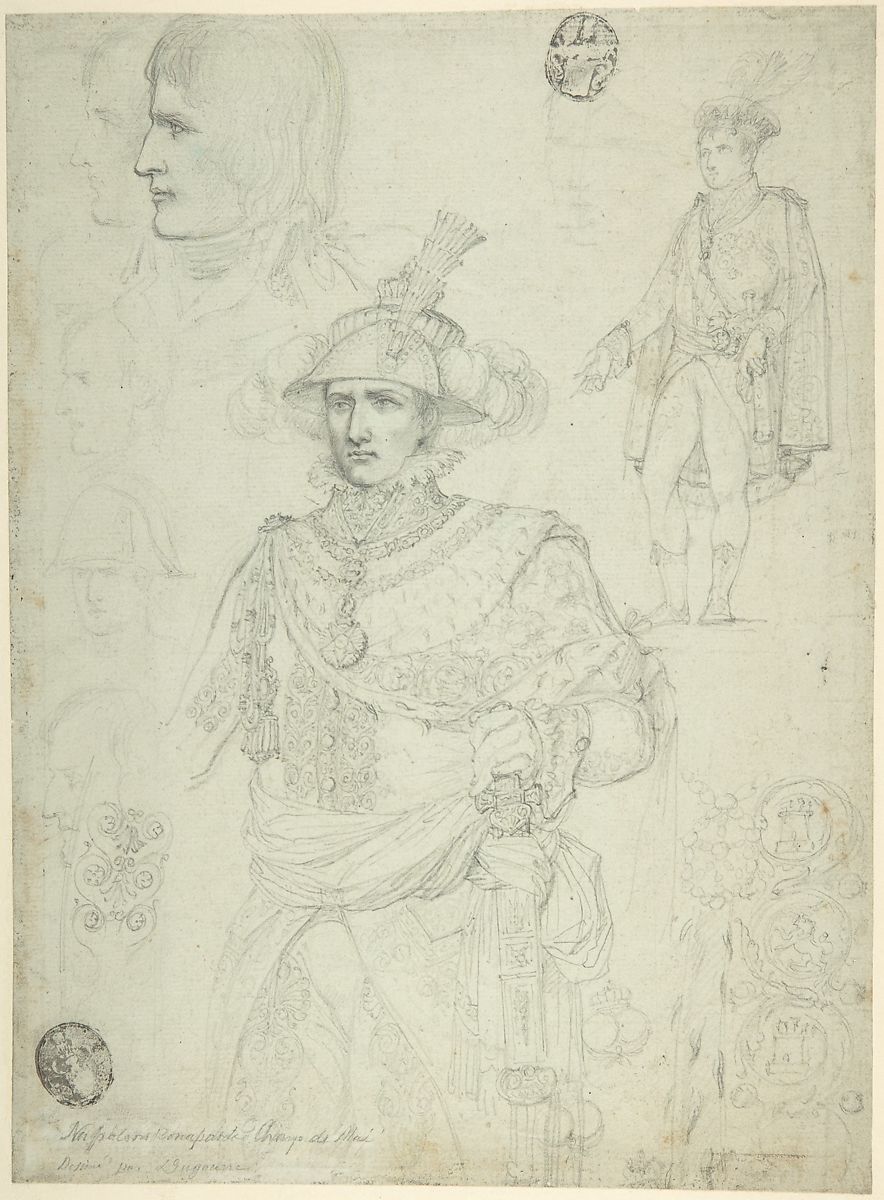
Napóleon a Mars-mezőn. Jean Démosthène Dugourc rajza.
Napoléon on the Champ de Mars. Sketch made by Jean Démosthène Dugourc.
Napoléon am Marsfeld. Skizze von Jean Démosthène Dugourc.
Napoléon pe Champ de Mars. Schiță realizată de Jean Démosthène Dugourc.
(kb./ca. 1815)
Source of the photo: https://bit.ly/2Anj8E0
(HU) 1815. június 1-én ‒ közvetlenül egy ezen kérdésre vonatkozó népszavazás után ‒ I. Napóleon francia császár ünnepélyes keretek között, a párizsi Mars-mezőn (7. kerület, ma az Eiffel-torony is ebben a parkban található) letette az esküt az új francia alkotmányra.
A március 20-án Párizsba bevonult császár április 22-én írta alá a francia alkotmányt kiegészítő okmányt (Acte additionnel aux constitutions de l'Empire), amely a svájci számazású Henri-Benjamin Constant író (Napóleon egykori politikai ellenfele) műve volt. Ennek értelmében a császár ‒ aki „Isten és az alkotmányok kegyelméből uralkodik” ‒ a parlamenttel együtt gyakorolja a törvényhozó hatalmat. A parlament két részből állt: a uralkodó által kinevezett Főúrak kamarájából (Chambre des paires) és a válaszott Képviselők kamarájából (Chambre de représentants).
(EN) On June 1, 1815, right after the conclusion of the referendum regarding this topic and, French Emperor Napoléon I took, in ceremonial circumstances, an oath on the new French constitution on the Field of Mars (7th district, today the Eiffel tower is also located in this park) in Paris.
Napoleon, who entered Paris on March 20, signed on April 22 the additional act that supplemented the French constitution (Acte additionnel aux constitutions de l'Empire). The document was written by the Swiss writer Henri-Benjamin Constant (a former political enemy of Napoleon). According to this document, the legislative power was exercised by the Emperor (who ruled “by the grace of God and of the constitutions”) and the parliament. The latter of formed by two chambers: the the appointed Chamber of Peers (Chambre des paires) and the elected Chamber of Representatives (Chambre de représentants).
A fiatal Napoleon, a francia hadsereg emelkedő csillagaként.
The young Napoleon as the rising star of the French army.
Der junge Napoleon als der steigende Stern der französischen Armee.
Tânărul Napoleon ca și steaua ascendentă a armetei franceze.
(kb./ca.1795‒1797)
(RO) Pe 1 iunie 1815, imediat după referendumul pe această temă și în condiții ceremoniale, împăratul fracez Napoléon I. a depus jurământul pe noua constituție franceză pe Câmpia lui Marte (districtul nr. 7, în prezent tot aici se află și turnul Eiffel).
Napoleon, care a intrat în Paris la 20 martie, a semnat la data de 22 aprilie actul adițional, care a completat constituția franceză (Acte additionnel aux constitutions de l'Empire), și care a fost, prin excelență, opera scriitorului elvețian Henri-Benjamin Constant (fost inamic politic al lui Napoleon). Confrom acesteia, puterea legislativă era exersată de împărat (care domnea „din mila lui Dumnezeu și a constituțiilor”) și de parlament. Acesta din urmă era compus din două camere: Camera Domnilor (Chambre des paires, al cărei membrii erau numiți de împărat) și de Camera reprezentanților (Chambre de représentants, membrii fiind aleși).
(DE) Am 1-sten Juni 1815, sofort nach einen Referendum und als einen Festakt, hat der französische Kaiser, Napoléon I. einen Eid auf die neuen Verfassung in dem Marsfeld im Paris (7. Bezirk, jetzt ist der Eiffelturm auch hier) geschworen.
Am 22-sten April hat Napoleon, der am 20-sten März Paris betrat, das zusätzliche Gesetz zur französischen Verfassung (Acte additionnel aux constitutions de l'Empire) unterschreiben. Das Dokument wurde von Henri-Benjamin Constant, ein Autor schweizer Herkunft und ehemaliger politischer Feind von Napoleon, geschrieben. Laut den Dokument, übte der Kaiser (der „von Gottes Gnade und der Verfassungen” herrschte) und das Parlament die gesetzgebende Gewalt aus. Das Parlament besteht aus zwei Teilen: die ernannte Pairskammer (Chambre des paires) und die gewählte Abgeordnetenkammer (Chambre de représentants).
The first case of animated reflection of the distant past that I want to present can be seen in the pilot episode of the series The Real Adventures of Jonny Quest which was a sequel of the original show from the ‘60s and its ‘80s renewal, airing for two seasons (summing up a total of 56 episodes). The show was an interesting experiment which presented the adventures of Dr. Benton Quest, a renowned scientist who is equipped with multiple gadgets, has land, air and water vehicles, as well as good connection with the government of the United States of America (USA), his bodyguard and a former ‒ as called by general Tyler in the first season ‒ “Special Operations cowboy”, Race Bannon, and their adolescent children, Jonny Quest, Hadji Singh (natural, respectively adopted son of Dr. Quest) and Jessie (the daughter of Bannon), who find the legendary city of El Dorado (“The Realm of the Condor”), encounter (among others) ghosts, a demon who possesses the body of women (“Eclipse”), an envoy of an advanced outer space civilization who is elected Vice-President of the USA (“Alien in Washington”), werewolves (“In the Darkness of the Moon”), cryptozoological beings like yetis (“Expedition to Khumbu”), the Jersey Devil (“The Specter of the Pine Barrens”) and the wild man of Borneo (“Amok”), and fight notable recurring foes like Dr. Jeremiah Surd (a paralyzed former scientist who came up with a nerve gas) and Ezekiel Rage (the disfigured and vengeful former secret agent left behind in a fictional Central/Southern American country where his family died in a car crash). The show also features a 3D virtual reality simulator called Questworld which can be used both for training, communicating with alien entities and fighting menaces.
(Back in the late 1990s, when I was a child, the series was a great, captivating, intriguing and, sometimes, frightening experience for me.)
Here is the intro of the series:
The pilot of the series (entitled “The Darkest Fathoms”) premiered on August 26, 1996 and presented the story of a haunted pirate ship. It opened with a naval battle between a ship of the line of the British navy and a smaller pirate ship, a frigate, named the “The Ivory Web”. During the intensive gunfight and cannon fire, the pirate commander gives the order “Fire at will.” The deck of the frigate is hit on a spot where a cannon manned by five pirates is on the verge of being fired. The explosion blows the men away and tosses the cannon backwards. The captain runs to the cannon and pushes it back to fire at the other vessel. The picture then cuts to the officers of the other ship who are witness to this scene. One of them, the commander calls upon the pirate leader:
-Strike your collars, Black Jack Lee! Surrender your ship!
-Never! Alive or dead, what is mine is mine!-replies the pirate, while the picture first show him, after suddenly closes on his face. -What you call yours belongs rightly to his Britannic Majesty! You must pay the price for you treason and piracy but, at least spear your crew this carnage!
After an initial laugh, the pirate captain replies: If you give my men the choice of dying, here, a dancing at the end of your yardarms, Horatio! I believe they will stand fast with me!
After saying this, he ignites the primer quill of the cannon with a match and fires it in the direction of the British officers he is replying to. The cannonball hits the ship, very close to the location of the officers but none of them is visibly injured, although the commander fell to his knees as a result of the impact. He is helped up by his seconds and, in a visibly angry manner, he gives the following instruction: “Order: give no quarter and take no prisoners.”
The Ivory Web finally receives three major hits and begins to sink. The frigate tips towards the larger ship with the three masts of the former hitting the deck of the latter. The commander gives order to set it free, turning to his second and saying: “My youth, I will not sink with that murderous villain!”The sailors cut the ship loose and it moves away from the British ship as it begins its stern first descent. The remaining pirates throw themselves into the water, leaving Black Jack Lee the only one to remain on the frigate. As he climbs up towards the prow, the commander asks the rhetoric question: “How could a man with the learning, the record and the courage of Jack Lee become so monstrous, a renegade?”
As The Ivory Web flips to vertical position, Black Jack Lee, who is holding on to the bowsprit, declares: “In life or death, no one shall have what is Black Jack Lee’s.” The commander throws an angry gaze at him while the color of his hair and that of his eyebrows turn from grey to white.
The person and the life story of the pirate Black Jack Lee (born John Milton Lee), a former aristocrat officer and “once a rising star in the British navy” who was dismissed because of his cruelty and who bought the navy’s ship which he commanded, The Ivory Web, becoming a pirate afterwards, is fictional, although there were some historical personalities who had a similar path of life. One of the best examples is Englishman Francis Verney /1584-1615/ who was born to a noble family (both his half-brother, Edmund /1590 or 1596-1642/ and Edmund’s namesake son /1616-1649/ fought in the English civil war, the former was killed in the battle of Edgehill, while Edmund the younger died in the line of duty as commander of the infantrymen of the defending force at the siege of Drogheda, during the conquest of Ireland by Lord Protector Oliver Cromwell /1599-1658/) he left England, after losing a lawsuit against his father’s widow regarding his inheritance of the family fortune, became an adventurer, a mercenary and a corsair of the Barbary Coast.
“Nelson English Admiral”
A reproduction of Lemuel Francis Abott's oil painting from 1797 from the following Hungarian book:
Mangold L., Horváth C. and Ballagi A. (eds.): A legújabb kor. Napóleon kora. Tolnai világtörténelme. [The most recent age. The age of Napoleon. The world history of Tolnai] vol. 15., Budapest, 1929. 90.
Jack Lee mentions the given name of the superior officer commanding the British ship: Horatio, who is wearing a black eye-patch and has only one arm. Taking this description into account and adding to it that Lee ‒ according to one of the episode’s characters ‒ “died 200 years ago” (which indicates that the above-described fictional event took place sometime in the late 1790s), we can assert that this character is none other than Lord Horatio Nelson /1758-1805/, 1st Viscount Nelson, knight of the Order of the Bath, Rear-Admiral of the British Royal Navy. He is probably best known as the victor of the Battle of the Nile (1-3 August 1798) and the Battle of Trafalgar (21 October 1805) in which he defeated the naval forces of Napoleon Bonaparte /1769-1821/.
This version of Horatio Nelson shows two battle marks which correspond to the injuries he suffered during his service. He was blinded in his right eye after being wounded during the siege of Calvi (12 July 1794) where he fought as part of the British expeditionary force sent to help the Corsicans who rebelled against the Jacobin French government. Three years and 12 days later, he commanded a British squadron with the ordered to land at Santa Cruz de Tenerife, located on the island of Tenerife, part of the Canary Islands. During a nighttime fight, the British troops were met with fierce resistance and the young Rear-Admiral was shot in the arm and was seriously wounded. As a result, his right arm was amputated.
(Personally, I consider it ironical that Nelson, who won two major battles on sea against the French, respectively Franco-Spanish forces of Napoleon, was scared on the island where Napoleon was born and he suffered one of his worst defeats, not to mention being basically crippled during the military operation, on Spanish waters. Beside this, I would also mention the fact that there is a street in Santa Cruz de Tenerife named after him, Calle de Horacio Nelson.)
This cartoon version of Lord Nelson contains three factual errors: 1.) Nelson most probably never wore an eye-patch to conceal his blindness. This error is most probably derived from the 1941 biopic starring future Lord Laurence Olivier /1907-1989/ as the admiral, who wears an eye-patch during the movie, 2.) his eye-patch is on his left eye which is incorrect and 3.) the character appears to be in his mid-50s going on to 60. This is also wrong because Nelson (born in 1758) was only 47 years old at the time of his death. The naval battle takes place in the late 1790s, when he was around 40 or, at best, in his early 40s.
The way he wears the right sleeve of his uniform (tied up to the left side of his chest, as depicted in the above-inserted picture) is presented correctly. Nelson is depicted like this in a number of paintings made by several contemporary artists (William Beechey, Lemuel Francis Abbott, Guy Head).
Conclusion
In the pilot episode (“The Darkest Fathoms”) of the series The Real Adventures of Jonny Quest, one can see a cartoon version of British Admiral Lord Horatio Nelson which, although contains three major errors (his eye-patch - which he, most probably, never wore - is on the wrong eye and he is about a decade and a half older than he should have been at the presumable time of the battle), is relatively believable.
DISCLAIMER: The pictures which are featured in the present blog post are all screenshots from the cartoon series. These were made with the aid of the print screen (PrtSc) feature of the laptop. I don’t own the above-mentioned cartoon series and no copyright infringement was intended by using the copies obtained with print screen feature.
A malomról 1741-ből van az első adat, bár valószínűleg már három évtizeddel korábban is létezett. Vízjele már a XVIII. század utolsó harmadából ismert, 1797-ben építették újjá. Tévesen a Heltai Gáspár-féle malommal, valamint az egykor mellette álló, ún. „réti” lisztelő malommal is azonosították. Eleinte a jezsuita rendhez tartozott, utóbb több bérlőjét (Manvilovits Emánuel, Bogdánffy Gábor, Dietrich Sámuel) is ismerjük.
Primele informații legate de moară provin din anul 1741, însă aceasta s-ar putea să fi existat deja cu cel puțin trei decenii înainte de data menționată. Filigranul morii provine din ultima treime a secolului al XVIII-lea, moara a fost reclădită în 1797. A fost confundată atât cu moara lui Gáspár Heltai, cât și cu așa-numita moară de făină „din luncă”, aflată odinioară în vecinătatea acesteia. Inițial a ținut de ordinul jezuit, însă cunoaștem și numele arendașilor ulteriori (Emánuel Manvilovits, Gábor Bogdánffy, Sámuel Dietrich).
pákei Pákei Lajos
Lajos Pákei de/von/of Páke
(1853–1921)
(HU) A felújítás alatt levő bécsi Parlament épülete, mely 1874 és 1883 között épült Theophil Hansen (1813–1891) dán származású építész tervei alapján. A munkálatokban ott találunk egy Bécsben tanuló kolozsvári fiatal Hansen-növendéket, Pákei Lajost (1853–1921). Ő lesz a későbbiekben Kolozsvár főépítésze, aki olyan épületeket tervezett meg, mint pl. a sétatéri Kioszt, a Kaszinót, a műszaki egyetem Malom utcai épületeit, valamint a New York (később Continental) szállodát és az Unitárius Kollégium épületét.
Az általa tervezett Majális utcai egykori családi villájába (ma a Babeș-Bolyai Tudományegyetem Pszichológiai Karához tartozik) több olyan reneszánsz ajtó- és ablakkeretet építtetett be, amelyek időközben lebontott kolozsvári házakból kerültek elő.
(RO) Clădirea parlamentului vienez, aflată în curs de restaurare. Construită între 1874 și 1883, după planurile arhitectului Theophil Hansen (1813-1891), originar din Danemarca. La construcția acestei clădiri îl găsim pe tânărul clujean Lajos Pákei (1853-1921), studentul lui Hansen. Mai târziu, el a deveni arhitectul-șef al orașului Cluj, care a proiectat clădirea Chiosului din Parcul Central, Casinoul, clădirile Universității Tehnice de pe strada George Barițiu, precum și Hotelul New York (mai târziu Continental), respectiv clădirea Colegiului Unitarian.
În vila familiei din strada Republicii, proiectat tot de către el, (în prezent aparține de Facultatea de Psihologie din cadrul Universității Babeș-Bolyai) au fost zidite mai multe rame de uși și de ferestre din perioada renașterii, care proveneau din clădiri clujene demolate între timp.
(EN) The building of the Austrian Parliament, currently under renovation. It was built between 1874 and 1883, according to the plans of Danish-born Theophil Hansen (1813–1891). Among those involved in its construction, we find a young man from Kolozsvár/Cluj/Klausenburg, Lajos Pákei (1853–1921), one of Hansen's students. Later, he would go on to become the chief architect of Kolozsvár/Cluj/Klausenburg, who planned the Chios in the Central Park, the Casino, the buildings of the Technical University located on the Malom (Hung. mill, now George Barițiu) Street, as well as the New York (later Continental) Hotel and the building of the Unitarian College.
His former villa, located on the Majális (now Republicii) Street, which was also planned by him, has Renaissance door-frames and window-frames built in. These were salvaged from demolished buildings of the city. The building currently belongs to the Faculty of Psychology of Babeș-Bolyai University.
(DE) Die Wiener Parlamenstgebäude, die jetzt restauriert ist. Es wurd zwischen 1874 und 1883, nach den Pläne von Theophil Hansen (1813-1891), Architekt dänischer Herkunft. Am dem Bauarbeiten nahm ein junger Klausenburger und ein Student von Hansen, Lajos Pákei (1853-1921) teil. Später wurde er Hauptarchitekt seiner Geburtsstadt und nach seine Entwürfe wurde die Gebäude der Chios (Zentralpark), des Kasinos, der Techinischen Universität am Malom-Straße (ung. Mühle-Straße, heute George Barițiu-Straße), als auch des Hotels New York (spät. Continental) und die Gebäude der unitarischen Hochschule gebaut.
Seine ehemalige und von ihm gelannte Villa am Majális (heute Republicii)-Straße, die jetzt zur Fakultät der Psychlogie der Universität Babeș-Bolyai gehört, nimmt Tür- und Fensterzargen von der Zeit der Renaissance auf. Diese waren von zerstörte klausenburger Gebäude gerettet.
Források/Surse/Sources/Quellen:
-Gaal, György: Kolozsvár. Millenniumi kalauz. Polis Könyvkiadó, Kolozsvár, 2001.
-Idem: Pákei Lajos. In: Idem: Születtek Kolozsvárt. Tizennyolc pályakép nagyjainkról, a város hétszáz esztendős történetébe foglalva, közel háromszáz illusztrációval és számos színes műmelléklettel. Polis Könyvkiadó, Kolozsvár, 2016. 183–203.
-Idem: Kolozsvár műépítésze: Pákei Lajos. In: Idem.: Kolozsvár vonzásában. Pallas-Akadémia Könyvkiadó, Csíkszereda, 2005. 242–248.
(HU) Karl Philipp zu Schwarzenberg herceg, tábornagy (Bécs 1771. ápr. 15.–Lipcse 1820. okt. 15.) bécsi lovasszobra. Schwarzenberg volt úgy az 1812-es oroszországi hadjáratban résztvevő (és I. Napóleon francia császár mellett harcoló), mint az 1813-as a lipcsei népek csatájában (Napóleon ellen harcoló) Habsburg-haderő főparancsnoka. Ezenkívül az Osztrák Császárság párizsi nagykövete is volt.
Három fiának egyike, Karl Philip Borromaeus zu Schwarzenberg (Bécs 1802. jan. 21.–Uo. 1858. jún. 25.) táborszernagy Erdély katonai kormányzója volt 1851 és 1858 között, Nagyszeben székhellyel.
Az Ernst Hähnel szobrász (1811–1891) által megalkotott lovasszobrot 1867-ben avatták fel. Egy komoly szépséghibája van: ha egy lovasszobor lovának egyik mellső lába a levegőben van, azt jelenti, hogy az ábrázolt személy a csatában szerzett sebesülésbe/betegségbe halt bele. Schwarzenberg 1820-ban hunyt el, egy agyvérzést követően, és nem harcban szerzett sérülés miatt.
(RO) Statuia ecvestră a prințului Karl Philipp zu Schwarzenberg (Viena 15 aprilie 1771-Leipzig 15 octombrie 1820). Schwarzenberg a fost atât comandantul armatei habsburgice, care a participat (de partea împăratului Napoleon I al Franței) în campania din Rusia din 1812, cât și a celei care a luptat (împotriva lui Napoleon) în bătălia popoarelor de la Leipzig din 1813. Totodată a fost și ambasadorul Imperiului Austriac la Paris.
Unul dintre cei trei fii de-ai lui, generalul de intendență Karl Philip Borromaeus zu Schwarzenberg (Viena 21 ianuarie 1802-tot acolo 25 iunie 1858) a fost guvernatorul militar al Transilvaniei între 1851 și 1858, cu reședința la Sibiu.
Statuia lui, realizată de sculptorul Ernst Hähnel szobrász (1811–1891), a fost inaugurată în 1867. Aceasta însă are o eroare majoră: în cazul în care calul dintr-o statuie ecvestră are unul dintre picioarele de față ridicat deasupra solului, înseamnă că personalitate care o călărește a murit în urma rănii suferite/bolii contractate în bătălie. Schwarzenberg s-a stins din viață în 1820, în urma unui atac cerebral, și nu din cauza rănilor primite în luptă.
(EN) The equestrian statue of field marshal Charles Philipp, Prince of Schwarzenberg (Vienna, April 15, 1771-Leipzig October 15, 1820) in Vienna. Schwarzenberg was the commander of the Habsburg army that participated (alongside emperor Napoleon I of France) in the Russian campaign of 1812, as well as the Habsburg forces that fought (against Napoleon) in the Battle of Nations at Leipzig in the following year. Besides, he was the ambassador of the Austrian Empire in Paris.
One of his three sons, Feldzeugmeister Karl Philip Borromaeus zu Schwarzenberg (Vienna, January 21, 1802-same place, June 25, 1858) was the military governor of Transylvania between 1851 and 1858, with headquarters at Nagyszeben/Sibiu/Hermannstadt.
The statue was made by sculptor Ernst Hähnel (1811-1891) and was unveiled in 1867. However, it contains a serious error: when the horse of an equestrian statue has one of its forefeet in the air, it means the rider died because of a wound/illness resulted from a battle. Schwarzenberg died in 1820, after a stroke and not because of a war injury.
(DE) Die Wiener Reiterstatue des Fürstes Karl Philipp zu Schwarzenberg (Wien, der 15-ten April 1771-Leipzig, der 15-ten Oktober 1820). Schwarzenberg war der Oberbefehlshaber der habsburgischen Armee, die an dem Feldzug von 1812 in Russland (an der Seite des Kaisers Napoleon I von Frankreich) teilgenommen hatte, und war auch der Kommandant der habsburgischen Truppen, die in der Völkersschlacht bei Leipzig (gegen Napoleon) gekämpft hatten.
Einer seiner drei Söhne, Feldzeugmeister Karl Philip Borromaeus zu Schwarzenberg (Wien, der 21-sten Januar 1802-ebenda 25-sten Juni 1858) war zwischen 1851 und 1858 Militär-Gouverneur von Siebenbürgen, mit Hermannstadt als Hauptquartier.
Die Statue wurde von Bildhauer Ernst Hähnel (1811-1891) hergestellt und war 1867 abgedeckt. Dennoch, hat es einen großen Fehler: falls das Pferd einer Reiterstatue einen Vorderfuß in der Luft hat, bedeutet es dass, der Reiter wurde von einer Feldverletzung/-krankheit gestorben. Schwarzenberg wurde 1820, nach einem Schlaganfall gestorben und nicht von einer Kampfsverletzung.
(HU) II. Henrik (1519‒1559, ur. 1547‒1559) francia király I. Ferenc fia (1494‒1547, ur. 1515‒1547), XII. Lajos (1462‒1515, ur. 1498‒1515) másodfokú unokatestvére, Lorenzo de’ Medici (1492‒1519, Firenze uralkodója 1516‒1519) veje, II. Ferenc (1544‒1560, ur. 1559‒1560), IX. Károly (1550‒1574, ur. 1560‒1574) és III. Henrik (1551‒1589, ur. 1574‒1589) édesapja.
(RO) Regele Henric al II-lea al Franței (1519‒1559, dom. 1547‒1559) a fost fiul lui Francisc I (1494‒1547, dom. 1515‒1547), vărul de gradul II al lui Ludovic al XII-lea (1462‒1515, dom. 1498‒1515), ginerele lui Lorenzo de’ Medici (1492‒1519, domnitorul Florenței 1516‒1519), tatăl lui Francisc al II-lea (1544‒1560, dom. 1559‒1560), al lui Carol al IX-lea (1550‒1574, dom. 1560‒1574) și al lui Henric al III-lea (1551‒1589, dom. 1574‒1589).
(EN) King Henry II of France (1519‒1559, r. 1547‒1559) was the son of Francis I (1494‒1547, r. 1515‒1547), first cousin twice removed of Louis XII (1462‒1515, r. 1498‒1515), son-in-law of Lorenzo de’ Medici(1492‒1519, Lord of Florence 1516‒1519), the father of Francis III (1544‒1560, r. 1558‒1560), of Charles IX (1550‒1574, r. 1560‒1574) and of Henry III (1551‒1589, r. 1574‒1589).
(DE) König Heinrich II. (1519‒1559, reg. 1547‒1559) war Sohn von Franz I. (1494‒1547, h. 1515‒1547), Cousin zweiten Grades von Ludwig XII. (1462‒1515, h. 1498‒1515), Schwiegeshon von Lorenzo de’ Medici(1492‒1519, Herrscher von Florenz 1516‒1519), Vater von Franz II. (1544‒1560, h. 1559‒1560), von Karl XII, (1550‒1574, h. 1560‒1574) und von Henrik III. (1551‒1589, h. 1574‒1589).


/cdn.vox-cdn.com/uploads/chorus_image/image/61150001/GettyImages_663750805.0.jpg)