A következő címkéjű bejegyzések mutatása: the Hundred Days. Összes bejegyzés megjelenítése

2021. április 22., csütörtök

04. 22. 1815. 04. 22.

Napóleon Bonaparte /1769‒1821/ francia császár.
Napoléon Bonaparte /1769-1821/ French emperor.
Napoléon Bonaparte /1769-1821/ împărat francez.
Napoléon Bonaparte /1769-1821/ französischer Kaiser.
Kép forrása/Photo's source/Sursa fotografiei/Quelle der Photo:
conf. univ. dr. Hahner Péter egyetemi docens

(HU) A március 20-án Párizsba bevonult Napóleon április 22-én írta alá a francia alkotmányt kiegészítő okmányt (Acte additionnel aux constitutions de l'Empire), amely a svájci számazású Henri-Benjamin Constant író műve volt. Ennek értelmében a császár ‒ aki „Isten és az alkotmányok kegyelméből uralkodik” ‒ a parlamenttel együtt gyakorolja a törvényhozó hatalmat. A parlament két részből állt: a uralkodó által kinevezett Főúrak kamarájából (Chambre des paires) és a válaszott Képviselők kamarájából (Chambre de représentants).
(RO) Napoleon, care a intrat în Paris la 20 martie, a semnat la data de 22 aprilie actul adițional, care a completat constituția franceză (Acte additionnel aux constitutions de l'Empire), și care a fost, prin excelență, opera scriitorului elvețian Henri-Benjamin Constant. Confrom acesteia, puterea legislativă era exersată de împărat (care domnea „din mila lui Dumnezeu și a constituțiilor”) și de parlament. Acesta din urmă era compus din două camere: Camera Domnilor (Chambre des paires, al cărei membrii erau numiți de împărat) și de Camera reprezentanților (Chambre de représentants, membrii fiind aleși).
(EN) Napoleon, who entered Paris on March 20, signed on April 22 the additional act that supplemented the French constitution (Acte additionnel aux constitutions de l'Empire). The document was written by the Swiss writer Henri-Benjamin Constant. According to this document, the legislative power was exercised by the Emperor (who ruled “by the grace of God and of the constitutions”) and the parliament. The latter of formed by two chambers: the the appointed Chamber of Peers (Chambre des paires) and the elected Chamber of Representatives (Chambre de représentants).
(DE) Am 22-sten April hat Napoleon, der am 20-sten März Paris betrat, das zusätzliche Gesetz zur französischen Verfassung (Acte additionnel aux constitutions de l'Empire) unterschreiben. Das Dokument wurde von Henri-Benjamin Constant, ein Autor schweizer Herkunft, geschrieben. Laut den Dokument, übte der Kaiser (der „von Gottes Gnade und der Verfassungen” herrschte) und das Parlament die gesetzgebende Gewalt aus. Das Parlament besteht aus zwei Teilen: die ernannte Pairskammer (Chambre des paires) und die gewählte Abgeordnetenkammer (Chambre de représentants).

2020. június 22., hétfő

Horváth Csaba: 22. 06. 1815. 06. 22.

Napóleon Bonaparte /1769‒1821/ francia császár.
Napoléon Bonaparte /1769-1821/ French emperor.
Napoléon Bonaparte /1769-1821/ împărat francez.
Napoléon Bonaparte /1769-1821/ französischer Kaiser.
Kép forrása/Photo's source/Sursa fotografiei/Quelle der Photo:
conf. univ. dr. Hahner Péter egyetemi docens

(HU) 1815. június 22-én ‒ négy nappal a Waterloo-nál elszenvedett vereség után ‒ került sor I. Napóleon francia császár második és egyben utolsó lemondására. Ezzel lezárult az ún. „száznapos uralom”  (les Cent-Jour). Négy éves fia, II. Napóleon javára mondott le. Új kormányt az addigi rendőrminiszter, Joseph Fouché alakított.

(EN) On 22 June 1815, four days after the defeat at Waterloo, French emperor Napoleon I abdicated for the second and last time. This marked the end of the so-called “Hundred Days” (les Cent-Jour). He abdicated in favor of his 4-year-old son, Napoleon II. Joseph Fouché, who until then was Minister of Police, formed a new government.

Joseph Fouché /1759‒1820/ Otrantó hercege, Fouché grófja, rendőrminiszter, majd miniszterlenök.
Joseph Fouché /1759-1820/ duke of Otranto, count of Fouché, Minister of Police, Prime Minister.
Joseph Fouché /1759-1820/ duce de Otranto, conte de Fouché, ministru de poliție, prim-ministru.
Joseph Fouché /1759-1820/ Herzog von Otranto, Graf von Fouché, Polizeiminister, Ministerpräsident
Kép forrása/Photo's source/Sursa fotografiei/Quelle der Photo:
Goerl Istváns: Különös emberek. Az otrantói herceg. Stefan Zweig új könyve a legfantasztikusabb politikai kalandorról.
Új Idők. 35. (1929) 42. 467.

(RO) Pe 22 iunie 1815, la patru zile după înfrângerea de la Waterloo, a avut loc a doua și ultima abdicare a împăratului francez Napoleon I. Acest fapt a însemnat sfârșitul al așa-numitei domnii a „celor o sută de zile” (les Cent-Jour). Acesta a renunțat la tron în favoarea fiului său, în vârstă de patru ani, Napoleon II. Noul guvern a fost format de Joseph Fouché, care până în acel moment a fost ministrul de poliție.

(DE) Am 22-sten Juni 1815, vier Tagen nach die Niederlage bei Waterloo, fand die zweite und letzte Abdankung des französischen Kaisers Napoleon I statt. Das war die Ende der sogennanten „Herrschaft der Hundert Tagen” (les Cent-Jour). Er verzichtete auf den Thron zugunsten von seinem 4-jährigen Sohn, Napoleon II. Joseph Fouché, der Polizeiminister, hat eine neue Regierung gebildet.

II. Napóleon /1811‒1832/ címzetes francia császár, Róma királya, Reichstadt hercege, „a Sasfiók”.
Napoléon II /1811-1832/ titular French emperor, King of Rome, Duke of Reichstadt, “the Eaglet ”.
Napoléon al II-lea /1811-1832/ împărat titular francez, regele Romei, ducele de Reichstadt, „Puiul vulturului”.
Napoléon II /1811-1832/ titularischer französischer Kaiser, König von Rom, Herzog von Reichstadt, „der junge Adler”.
Kép forrása/Photo's source/Sursa fotografiei/Quelle der Photo:
Magyarország. 34. (1927) 92. 15.

2020. június 16., kedd

Horváth Csaba: 16. 06. 1815. 06. 16.

(HU) 1815-ben két csata zajlott le ezen a napon: Arthur Wellesley, Wellington hercege vezette sereg vereséget mért Michel Ney marsall csapataira a Quatre Bras-i csatában.
A közelben, Ligny-nél ezzel párhuzamosan Napóleon császár legyőzte a poroszokat, akik Gebhard von Blücher parancsnoksága alatt harcoltak.
Napóleon ezzel egyelőre megakadályozta a két sereg egyesülését. A visszavonuló porosz sereg üldözésére a császár 30 ezer katonát küldött, Emmanuel de Grouchy marsall vezetése alatt.

Napóleon Bonaparte /1769‒1821/ francia császár.
Napoléon Bonaparte /1769-1821/ French emperor.
Napoléon Bonaparte /1769-1821/ împărat francez.
Napoléon Bonaparte /1769-1821/ Französischer Kaiser,
Kép forrása/Photo's source/Sursa fotografiei/Quelle der Photo:
conf. univ. dr. Hahner Péter egyetemi docens

(EN) In 1815, two battles took place on this day: Arthur Wellesley, the Duke of Wellington, defeated Marshal Michel Ney in the Battle of Quatre Bras.
Not far from there, Emperor Napoleon won the Battle of Ligny, defeating the Prussians led by Gebhard von Blücher.
With this, Napoléon, for the moment, prevented the two armies’ junction. The Emperor sent Marshal Emmanuel de Groucy with a 30,000-strong force to pursue the retreating Prussians.

Sir Arthur Wellesley /1769‒1852/, Wellington hercege, brit tábornagy, Anglia későbbi miniszterlenöke.
Sir Arthur Wellesley /1769-1852/, Duke of Wellington, British field marshall, future prime minister of England.
Sir Arthur Wellesley /1769-1852/, ducele de Wellington, feldmareșal birtanic, viitorul prim-ministru al Angliei.
Sir Arthur Wellesley /1769/1852/, Herzog von Wellington, britischer Feldmarschall, künftiger Ministerpräsident von England.
Kép forrása/Photo's source/Sursa fotografiei/Quelle der Photo:
Surányi Miklós: Aki legyőzte Napoleont. Új Idők. 42. (1935) 24. 879.

(RO) În 1815, în această zi au avut loc două bătălii: Ducele de Wellington, Arthur Wellesley a înfrânt trupele mareșalului Michel Ney în bătălia de la Quatre Bras.
În apropiere a avut loc și bătălia de la Ligny, în care împăratul Napoleon a învins forțele prusiace, conduse de generalul Gebhard von Blücher.
Napoléon a împiedicat, pentru moment, unirea celor două armate. Mareșalul Emmanuel de Grouchy, împreună cu 30 de mii soldați, a fost trimis de împărat să îi prigonească pe pruși.

Gebhard Leberecht von Blücher /1742‒1819/, Wahlstatt hercege, porosz tábornagy.
Gebhard Leberecht von Blücher /1742-1819/, prince of Wahlstatt, Prussian field marshall.
Gebhard Leberecht von Blücher /1742-1819/, prințul de Wahlstatt, feldmareșal prusac.
Gebhard Leberecht von Blücher /1742-1819/, Fürst von Wahlstatt, preuißscher Generalfeldmarschall.
Kép forrása/Photo's source/Sursa fotografiei/Quelle der Photo:
Anekdoten, Züge und Skizzen aus dem Leben des Königlich Preußischen Feldmarschalls Lebrecht von Blücher. Quedlinburg‒Leipzig, 1842.

(DE) Im Jahr 1815, an diesem Tag zwei Gefechen fanden statt: der Herzog von Wellington, Arthur Wellesley bringte die französichen Armee des Feldmarschalls Michel Ney bei eine Niederlage in der Schlacht bei Quatre Bras.
In der Nähe, Kaiser Napoleon siegte in der Schlacht bei Ligny gegen die Preußen des Generalfeldmarschalls Gebhard von Blücher.
Vorläufig, verhinderte Napoléon die Verbindung der zwei Armeen. Der Kaiser sendte Marschall Emmanuel de Grouchy und einen Heer, 30.000 Mann stark, um die Verfolgung der zurückweihenden Preußen.

Michel Ney /1769‒1815/, Elchingen hercege, Moszkva hercege, francia tábornagy.
Michel Ney /1769-1815/, Duke of Elchingen, Prince of the Moskva, French field marshall.
Michel Ney /1769-1815/, deucele de Elchingen, prințul Moscovei, feldmareșal francez.
Michel Ney /1769-1815/, Herzog von Elchingen, Fürst von der Moskva, französischer Feldmarschall.
Kép forrása/Photo's source/Sursa fotografiei/Quelle der Photo:
https://www.historyhit.com/facts-about-marshal-ney/

2020. június 1., hétfő

Horváth Csaba: 01. 06. 1815. 06. 01.

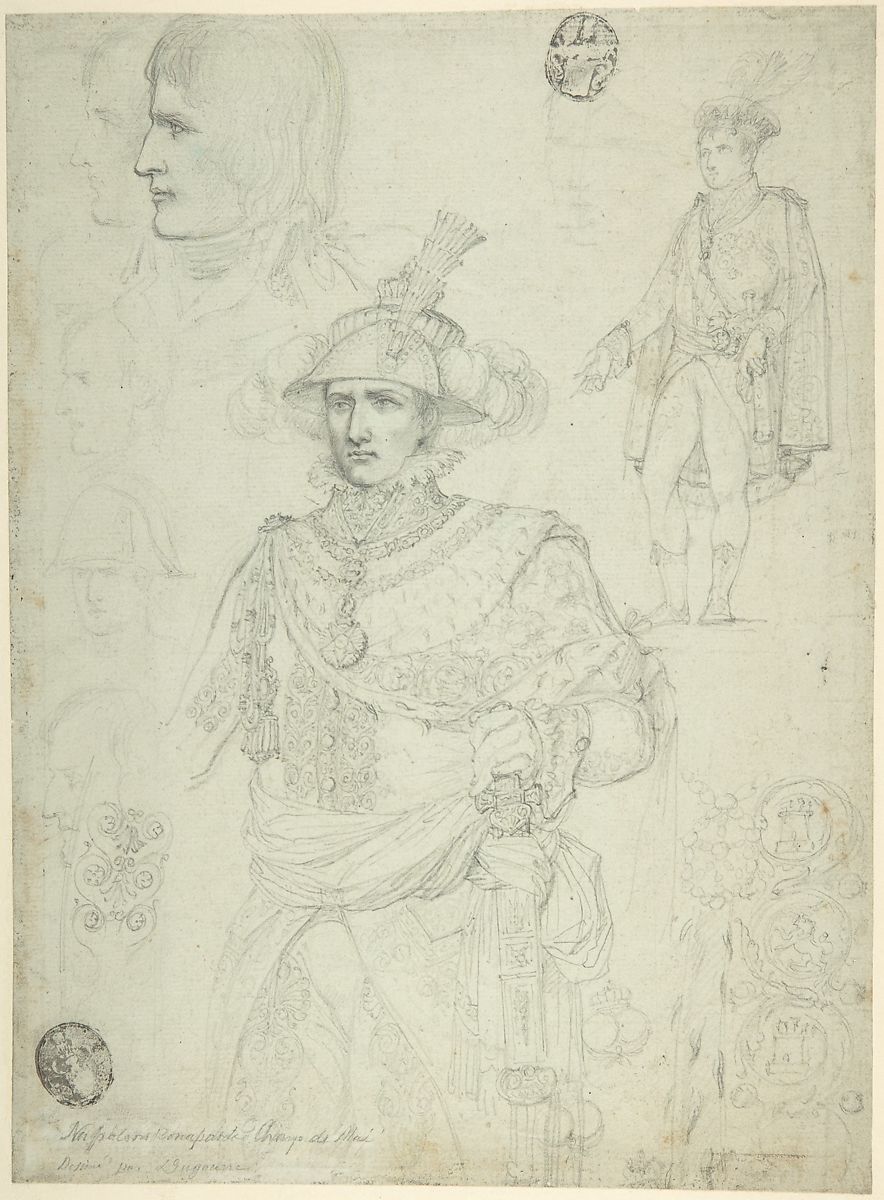
Napóleon a Mars-mezőn. Jean Démosthène Dugourc rajza.
Napoléon on the Champ de Mars. Sketch made by Jean Démosthène Dugourc.
Napoléon am Marsfeld. Skizze von Jean Démosthène Dugourc.
Napoléon pe Champ de Mars. Schiță realizată de Jean Démosthène Dugourc.
(kb./ca. 1815)
Source of the photo: https://bit.ly/2Anj8E0

(HU) 1815. június 1-én ‒ közvetlenül egy ezen kérdésre vonatkozó népszavazás után ‒ I. Napóleon francia császár ünnepélyes keretek között, a párizsi Mars-mezőn (7. kerület, ma az Eiffel-torony is ebben a parkban található) letette az esküt az új francia alkotmányra.
A március 20-án Párizsba bevonult császár április 22-én írta alá a francia alkotmányt kiegészítő okmányt (Acte additionnel aux constitutions de l'Empire), amely a svájci számazású Henri-Benjamin Constant író (Napóleon egykori politikai ellenfele) műve volt. Ennek értelmében a császár ‒ aki „Isten és az alkotmányok kegyelméből uralkodik” ‒ a parlamenttel együtt gyakorolja a törvényhozó hatalmat. A parlament két részből állt: a uralkodó által kinevezett Főúrak kamarájából (Chambre des paires) és a válaszott Képviselők kamarájából (Chambre de représentants).

(EN) On June 1, 1815, right after the conclusion of the referendum regarding this topic and, French Emperor Napoléon I took, in ceremonial circumstances, an oath on the new French constitution on the Field of Mars (7th district, today the Eiffel tower is also located in this park) in Paris.
Napoleon, who entered Paris on March 20, signed on April 22 the additional act that supplemented the French constitution (Acte additionnel aux constitutions de l'Empire). The document was written by the Swiss writer Henri-Benjamin Constant (a former political enemy of Napoleon). According to this document, the legislative power was exercised by the Emperor (who ruled “by the grace of God and of the constitutions”) and the parliament. The latter of formed by two chambers: the the appointed Chamber of Peers (Chambre des paires) and the elected Chamber of Representatives (Chambre de représentants).

A fiatal Napoleon, a francia hadsereg emelkedő csillagaként.
The young Napoleon as the rising star of the French army.
Der junge Napoleon als der steigende Stern der französischen Armee.
Tânărul Napoleon ca și steaua ascendentă a armetei franceze.
(kb./ca.1795‒1797)

(RO) Pe 1 iunie 1815, imediat după referendumul pe această temă și în condiții ceremoniale, împăratul fracez Napoléon I. a depus jurământul pe noua constituție franceză pe Câmpia lui Marte (districtul nr. 7, în prezent tot aici se află și turnul Eiffel).
Napoleon, care a intrat în Paris la 20 martie, a semnat la data de 22 aprilie actul adițional, care a completat constituția franceză (Acte additionnel aux constitutions de l'Empire), și care a fost, prin excelență, opera scriitorului elvețian Henri-Benjamin Constant (fost inamic politic al lui Napoleon). Confrom acesteia, puterea legislativă era exersată de împărat (care domnea „din mila lui Dumnezeu și a constituțiilor”) și de parlament. Acesta din urmă era compus din două camere: Camera Domnilor (Chambre des paires, al cărei membrii erau numiți de împărat) și de Camera reprezentanților (Chambre de représentants, membrii fiind aleși).

(DE) Am 1-sten Juni 1815, sofort nach einen Referendum und als einen Festakt, hat der französische Kaiser, Napoléon I. einen Eid auf die neuen Verfassung in dem Marsfeld im Paris (7. Bezirk, jetzt ist der Eiffelturm auch hier) geschworen.
Am 22-sten April hat Napoleon, der am 20-sten März Paris betrat, das zusätzliche Gesetz zur französischen Verfassung (Acte additionnel aux constitutions de l'Empire) unterschreiben. Das Dokument wurde von Henri-Benjamin Constant, ein Autor schweizer Herkunft und ehemaliger politischer Feind von Napoleon, geschrieben. Laut den Dokument, übte der Kaiser (der „von Gottes Gnade und der Verfassungen” herrschte) und das Parlament die gesetzgebende Gewalt aus. Das Parlament besteht aus zwei Teilen: die ernannte Pairskammer (Chambre des paires) und die gewählte Abgeordnetenkammer (Chambre de représentants).